Hallo. I am back, and today I am review another Dragonlance book, The Cataclysm:
Rating: 5 out of 5 Stars
Plot:
The Cataclysm. The event when the gods of Krynn threw a fiery mountain (or meteor, if you want to get technical) upon, the world, shattering it and ending Istar forever, and ushering in The Age of Despair. Here, we are given a series of short stories depicting how the people of the world survived the aftermath, surviving in a world that has been changed. With darkness reigning not only in the corners of the world, but in the hearts of the people as well, it will take special, strong heroes to find the light in a world without gods, a world without faith, a world of despair.
Like The Reign of Istar, this book has multiple plots from containing different stories written by different authors. Some where humorous and well written, while others were touching. The highlight of this book has to be the novella depicting the rise of Lord Soth, and how in a surprising twist he shows how darkness isn't a physical manifestation but an inward choice.
Caution:
Characters in peril, with some blood and broken limbs. Uses of h-word and d-word.
Lessons:
A person's true worth isn't found in their outer appearance, their rank, or their nationality, but in their heart and soul. We should strive to have faith even when those around us choose not to. Even when it doesn't appear so, light and goodness still abound.
Showing posts with label Dragons. Show all posts
Sunday, October 8, 2017
Tuesday, September 12, 2017
Book review: Dragons of Summer Flame signals beginning of the end
Hi everyone. I know it's bee a while, but I'm back. To signal the advance, I'm going to be doing a review for a book I finished this morning: Dragonlance: Dragons of Summer Flame.
Rating: 4 out of 5 stars
Story:
The War of the Lance is over. The heroes who have survived have moved on with their lives, started families of their own. However, things aren't peaceful in Krynn. Takhisis, the Queen of Darkness is still at work trying to rule the world and is sending her forces out to find strategic points. Among these locations are the island of the Irda, a race of beautiful beings who want nothing to be left alone. To do so, they turn to a mysterious item called the Greygem, believing that by cracking it open they will be able to keep themselves from being conquered by anyone. That turns out to be a huge mistake, as they end up releasing Chaos, the Father of All and None. Angry at having been imprisoned for so long, Chaos decides he will punish all his children by destroying the world of Krynn, pulling it back into the void from whence it came. Stopping Chaos will require something that has not happened in the history of the world: The complete alliance of everything. Good and evil. Light and dark. Every nation, every race, they must all put aside their differences and work together or the entire world will be erased from existence.
I've been enjoying reading the Dragonlance series ever since I picked up Dragons of Autumn Twilight. I did enjoy the story and the plot because it was an interesting idea to bring everyone together to fight against something that will destroy all of them. I did enjoy reading about how many of the characters I had spent the last few books reading about moved on with their lives. However, I had to deduct a star because I found the ending lacking. I just wasn't pleased with it like I was with the other books. I won't give away spoilers, but I'm not sure I'll be continuing the series into the new age of Krynn.
Caution:
Some uses of the d-word and h-word. One use of the g-word. The appearance of Chaos may be in written word, but the description given to fuel the imagination might create the stuff of nightmares. People are killed, and blood is mentioned.
Lessons:
We must honor our parents, but we must also be allowed to choose our own paths in life. Learning from the examples of our ancestors can help us make tough decisions. People can still be redeemed from poor choices they made in life.
Rating: 4 out of 5 stars
Story:
The War of the Lance is over. The heroes who have survived have moved on with their lives, started families of their own. However, things aren't peaceful in Krynn. Takhisis, the Queen of Darkness is still at work trying to rule the world and is sending her forces out to find strategic points. Among these locations are the island of the Irda, a race of beautiful beings who want nothing to be left alone. To do so, they turn to a mysterious item called the Greygem, believing that by cracking it open they will be able to keep themselves from being conquered by anyone. That turns out to be a huge mistake, as they end up releasing Chaos, the Father of All and None. Angry at having been imprisoned for so long, Chaos decides he will punish all his children by destroying the world of Krynn, pulling it back into the void from whence it came. Stopping Chaos will require something that has not happened in the history of the world: The complete alliance of everything. Good and evil. Light and dark. Every nation, every race, they must all put aside their differences and work together or the entire world will be erased from existence.
I've been enjoying reading the Dragonlance series ever since I picked up Dragons of Autumn Twilight. I did enjoy the story and the plot because it was an interesting idea to bring everyone together to fight against something that will destroy all of them. I did enjoy reading about how many of the characters I had spent the last few books reading about moved on with their lives. However, I had to deduct a star because I found the ending lacking. I just wasn't pleased with it like I was with the other books. I won't give away spoilers, but I'm not sure I'll be continuing the series into the new age of Krynn.
Caution:
Some uses of the d-word and h-word. One use of the g-word. The appearance of Chaos may be in written word, but the description given to fuel the imagination might create the stuff of nightmares. People are killed, and blood is mentioned.
Lessons:
We must honor our parents, but we must also be allowed to choose our own paths in life. Learning from the examples of our ancestors can help us make tough decisions. People can still be redeemed from poor choices they made in life.
Thursday, May 5, 2016
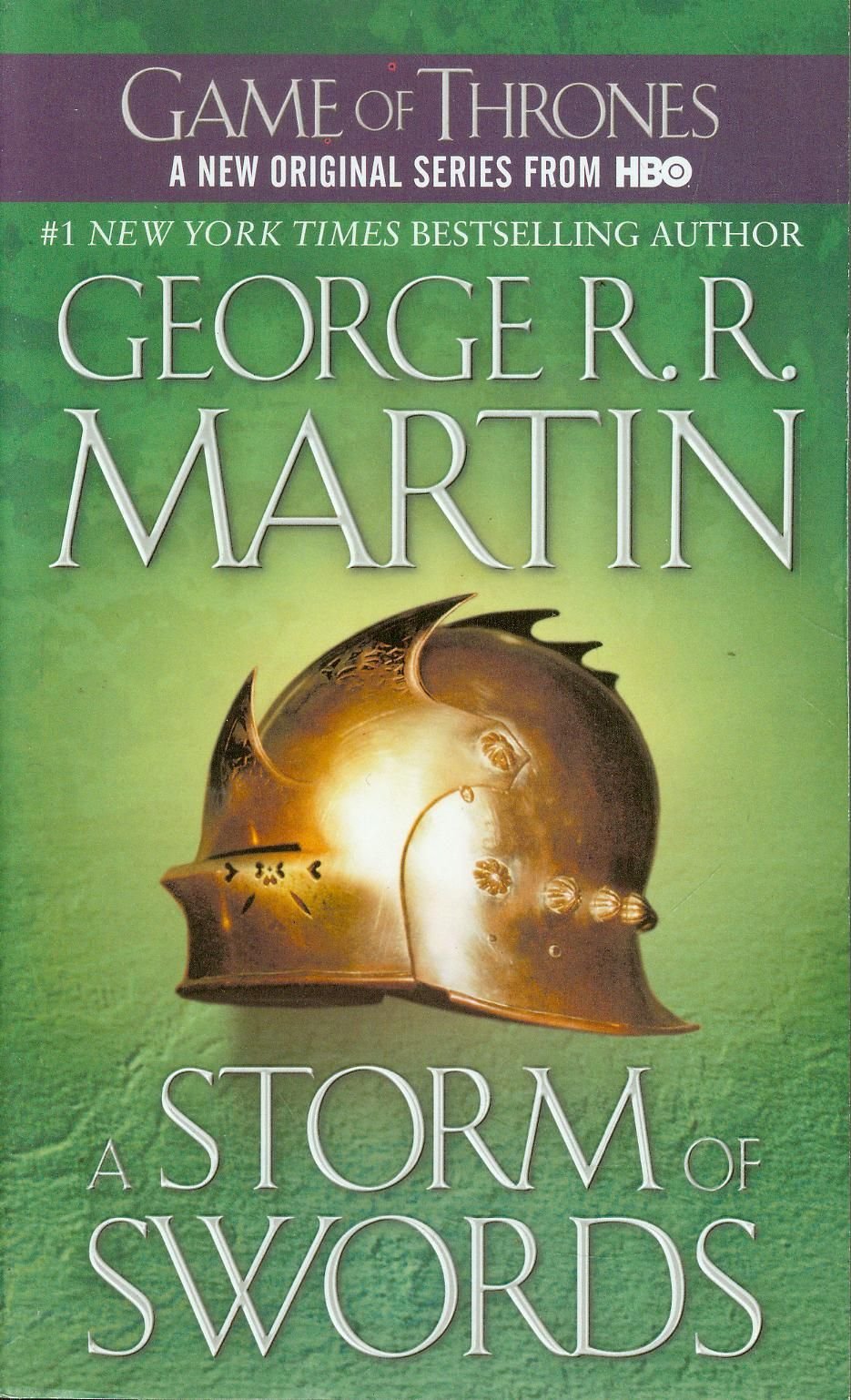
Book review: A Storm of Swords is a must-read
Hello everyone. I'm back after a long absence. I've got some books to review with all of you. The first one today is A Storm of Swords.
Rating: 5 out of 5 stars
Story:
War continues to rage across the Seven Kingdoms of Westeros. Tyron Lannister has managed to repel the forces of Stannis Baratheon, and is left with nothing after his father and nephew take all the credit. Robb Stark continues to work to avenge his father, but his actions are causing problems in the ranks of his own men. Meanwhile, beyond the Wall, Jon Snow is trying to learn the plans of Mance Rayder, the King-Beyond-The-Wall, while he ends up getting too close to the wildling Ygritte. Arya Stark is still trying to get back to her mother and brother, but ends up having to deal with outlaws and bandits who have their own plans for her. Meanwhile, across the sea, Daenerys Targaryan is building an army of slaves and sellswords to sail to Westeros to take back the Iron Throne. In amongst all this conflict there is betrayal, conspiracies, schemes, and assassinations around every corner. Every man is looking out for himself while all around them the Storm of Swords rages on.
This book took me over a month to read, but it was worth every second. George R. R. Martin is a modern-day master of fantasy, stepping on the foundation that both J. R. R. Tolkien and history itself has laid, and combined the two of them to create one of the most realistic worlds in the realm of fantasy. In Westeros things are not black and white. There is a lot of grey in there, and you can see that in the people and the reasons they give for doing what they do. Characters you care about are not safe from the ravages of war and evil, and we see that even good people do bad things. His descriptions are very detailed and he really explores the psychological processes in each of his characters. So pick up a copy and be sure to join the adventure.
Caution:
Heavily language, including multiple use of the F-word. There is explicit sex and nudity, and often you'll have to skip entire pages before you can continue again. There is a lot of gore and violence, which would probably shock your parents if they could see the images your imagination projects with this book. Some terrifying moments.
Lessons:
As soon as men get a little power, they will exercise unrighteous dominion. Be careful of who you trust. Doing what is right sometimes means telling others no, and getting scorned for it.
Rating: 5 out of 5 stars
Story:
War continues to rage across the Seven Kingdoms of Westeros. Tyron Lannister has managed to repel the forces of Stannis Baratheon, and is left with nothing after his father and nephew take all the credit. Robb Stark continues to work to avenge his father, but his actions are causing problems in the ranks of his own men. Meanwhile, beyond the Wall, Jon Snow is trying to learn the plans of Mance Rayder, the King-Beyond-The-Wall, while he ends up getting too close to the wildling Ygritte. Arya Stark is still trying to get back to her mother and brother, but ends up having to deal with outlaws and bandits who have their own plans for her. Meanwhile, across the sea, Daenerys Targaryan is building an army of slaves and sellswords to sail to Westeros to take back the Iron Throne. In amongst all this conflict there is betrayal, conspiracies, schemes, and assassinations around every corner. Every man is looking out for himself while all around them the Storm of Swords rages on.
This book took me over a month to read, but it was worth every second. George R. R. Martin is a modern-day master of fantasy, stepping on the foundation that both J. R. R. Tolkien and history itself has laid, and combined the two of them to create one of the most realistic worlds in the realm of fantasy. In Westeros things are not black and white. There is a lot of grey in there, and you can see that in the people and the reasons they give for doing what they do. Characters you care about are not safe from the ravages of war and evil, and we see that even good people do bad things. His descriptions are very detailed and he really explores the psychological processes in each of his characters. So pick up a copy and be sure to join the adventure.
Caution:
Heavily language, including multiple use of the F-word. There is explicit sex and nudity, and often you'll have to skip entire pages before you can continue again. There is a lot of gore and violence, which would probably shock your parents if they could see the images your imagination projects with this book. Some terrifying moments.
Lessons:
As soon as men get a little power, they will exercise unrighteous dominion. Be careful of who you trust. Doing what is right sometimes means telling others no, and getting scorned for it.
Saturday, October 3, 2015
Book review: A Clash of Kings intensifies the series
Well it's time to do another review. This week I've finally finished reading the second book of A Song of Ice and Fire, A Clash of Kings.
Rating: 4 out of 5 stars
Story:
Westeros is being plunged into a civil war. Not only are the Lannister forces fighting against the armies of the North, but the people of King's Landing are starving and people across the Riverlands are being attacked. To make matters worse their are some men who are not interested in taking any side but their own. Stannous and Renly Baratheon, brothers of the late King Robert Baratheon, have declared themselves king and are waging war against each other. Whoever wins will go on to attack King's Landing. King Robb Stark of the North sends Theon Greyjoy back to the Iron Islands to enlist the help of his father, but only unleashes another power hungry man upon Westeros. Sansa, Arya, and Tyrion are caught up in the various aspects of the war while Jon and Daenerys are experiencing forces at work elsewhere in the world. Loyalties will be tested, friends and foes will rise, and no one will escape the clash of kings unscathed.
George R. R. Martin captures complex politics at work in the world of Westeros. It's hard for any writer to capture the workings of a world in the way Martin has. You can feel the pain and sorrow of many who want to help people, but can't for one reason or another. The human element is also strong here. Most authors tend to have different sides put aside petty differences to work together, but that does not work here. Many people are too set in their pride to listen to reason and as a result many suffer. I also love the amount of world building Martin has done in creating the city of Quarth and the history and lore in the wilds north of the Wall.
However this book does take an incredibly darker turn. He shows that there are darker powers at work in the world, some of them working behind the self-proclaimed kings in their struggle for the Iron Throne. Men and women alike also discuss things that are incredible inappropriate, mainly body parts that shouldn't be discussed except with their spouses. Still if you enjoyed the first book go ahead and pick it up. Just remember: read at your own risk.
Caution:
The F word appears at least twenty times. Several scenes are sexually explicit and graphic. A man is poisoned. Battles break out and there is blood and gore. A woman goes to see some warlocks and passes through a house of horrors, where corpses try to eat her. Some swearing.
Lessons:
When an unrighteous king comes to power it's the people who end up suffering. A tyrant will enforce his rule upon the people and force them to accept their way. Sometimes what we want isn't what is best for us. We all have gifts that we can use to help others. If we do not control our ambition, we can become something terrible.
Rating: 4 out of 5 stars
Story:
Westeros is being plunged into a civil war. Not only are the Lannister forces fighting against the armies of the North, but the people of King's Landing are starving and people across the Riverlands are being attacked. To make matters worse their are some men who are not interested in taking any side but their own. Stannous and Renly Baratheon, brothers of the late King Robert Baratheon, have declared themselves king and are waging war against each other. Whoever wins will go on to attack King's Landing. King Robb Stark of the North sends Theon Greyjoy back to the Iron Islands to enlist the help of his father, but only unleashes another power hungry man upon Westeros. Sansa, Arya, and Tyrion are caught up in the various aspects of the war while Jon and Daenerys are experiencing forces at work elsewhere in the world. Loyalties will be tested, friends and foes will rise, and no one will escape the clash of kings unscathed.
George R. R. Martin captures complex politics at work in the world of Westeros. It's hard for any writer to capture the workings of a world in the way Martin has. You can feel the pain and sorrow of many who want to help people, but can't for one reason or another. The human element is also strong here. Most authors tend to have different sides put aside petty differences to work together, but that does not work here. Many people are too set in their pride to listen to reason and as a result many suffer. I also love the amount of world building Martin has done in creating the city of Quarth and the history and lore in the wilds north of the Wall.
However this book does take an incredibly darker turn. He shows that there are darker powers at work in the world, some of them working behind the self-proclaimed kings in their struggle for the Iron Throne. Men and women alike also discuss things that are incredible inappropriate, mainly body parts that shouldn't be discussed except with their spouses. Still if you enjoyed the first book go ahead and pick it up. Just remember: read at your own risk.
Caution:
The F word appears at least twenty times. Several scenes are sexually explicit and graphic. A man is poisoned. Battles break out and there is blood and gore. A woman goes to see some warlocks and passes through a house of horrors, where corpses try to eat her. Some swearing.
Lessons:
When an unrighteous king comes to power it's the people who end up suffering. A tyrant will enforce his rule upon the people and force them to accept their way. Sometimes what we want isn't what is best for us. We all have gifts that we can use to help others. If we do not control our ambition, we can become something terrible.
Sunday, March 15, 2015
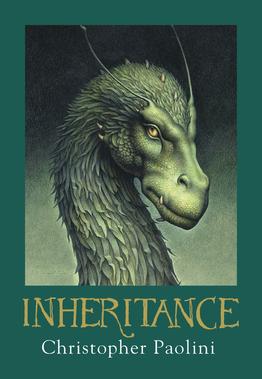
Book Review: Inheritance ended things in ways unexpected
Hi everyone. I just got done reading a book, and you know what that means: review time. This book is the fourth and final title in the Inheritance Cycle, Inheritance.
Rating: 4 out of 5 stars
Story:
The war to end the reign of Galbatorix has begun. As the Varden move through the empire capturing major cities Eragon and Saphira must prepare themselves for the time when they shall face the mad king. Too much is at stake for them to fail, and secrets of the past are revealing themselves. After an attack from the Empire on the Varden, Eragon and Sapphire learn of the location of the Rock of Kuthian, and must travel there in order to become more powerful to face Galbatorix. Will they find what they are looking for? Or will Alagaësia forever endure the rule of the mad king?
People have complained about how the elements of these books are similar to The Lord of the Rings and Star Wars. However people have been pointing out similarities in the Star Wars films to other myths and legends around the world, including but not limited to Japanese. It just shows that Paolini has done an extensive amount of research into old cultures and mythologies to create Alagaësia. The use of magic in this book is fun and exciting, and to be honest I never would've thought of the solutions that the characters came up with. The action sequences are well written and thought out. I also like how we see development in characters like Murtagh and Thorn. Most people would've ended the story with the death of Galbatorix, but Paolini goes on to include chapters on rebuilding Alagaësia after the war. It would've been nice if all the plot holes could've been wrapped up in the last few chapters, but for the most part this is a good end to an ambitious piece of work.
Caution:
Battles are waged, and men are often killed. Some creatures found in the story may be intimidating to younger readers. A woman is tortured and described as being in a shift. Booby traps kill people. Bones are broken, and blood is seen. Some mild swearing.
Lessons:
People have a right and a duty to protect their loved ones and their freedom from those who would seek to take them away. We should choose good and wise people to lead us. Our gifts and talents are best used to help and serve others. We can always change who we are. Learning from the past can help us face the future. There is no chance, fate, or destiny that can change or control the firm resolve of the human mind. Like Galbatorix, evil will try to paint its reasons and justifications as right.
Rating: 4 out of 5 stars
Story:
The war to end the reign of Galbatorix has begun. As the Varden move through the empire capturing major cities Eragon and Saphira must prepare themselves for the time when they shall face the mad king. Too much is at stake for them to fail, and secrets of the past are revealing themselves. After an attack from the Empire on the Varden, Eragon and Sapphire learn of the location of the Rock of Kuthian, and must travel there in order to become more powerful to face Galbatorix. Will they find what they are looking for? Or will Alagaësia forever endure the rule of the mad king?
People have complained about how the elements of these books are similar to The Lord of the Rings and Star Wars. However people have been pointing out similarities in the Star Wars films to other myths and legends around the world, including but not limited to Japanese. It just shows that Paolini has done an extensive amount of research into old cultures and mythologies to create Alagaësia. The use of magic in this book is fun and exciting, and to be honest I never would've thought of the solutions that the characters came up with. The action sequences are well written and thought out. I also like how we see development in characters like Murtagh and Thorn. Most people would've ended the story with the death of Galbatorix, but Paolini goes on to include chapters on rebuilding Alagaësia after the war. It would've been nice if all the plot holes could've been wrapped up in the last few chapters, but for the most part this is a good end to an ambitious piece of work.
Caution:
Battles are waged, and men are often killed. Some creatures found in the story may be intimidating to younger readers. A woman is tortured and described as being in a shift. Booby traps kill people. Bones are broken, and blood is seen. Some mild swearing.
Lessons:
People have a right and a duty to protect their loved ones and their freedom from those who would seek to take them away. We should choose good and wise people to lead us. Our gifts and talents are best used to help and serve others. We can always change who we are. Learning from the past can help us face the future. There is no chance, fate, or destiny that can change or control the firm resolve of the human mind. Like Galbatorix, evil will try to paint its reasons and justifications as right.
Wednesday, July 2, 2014
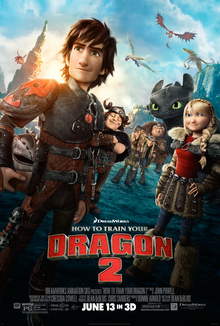
Review: How to Train Your Dragon 2 is better than the first!
Hi again. I have another movie review here. This one is definitely a must see.
Rating: Five out of Five Stars
Story
How to Train Your Dragon 2 takes place five years after the events of the first film and Berk has changed for the better. Vikings now get along with dragons and the entire island seems like a utopia. However while Hiccup and Toothless are out exploring they learn of a man named Drago Bludvist is creating a dragon army. While trying to find a peaceful solution and avoid war Hiccup and Toothless encounter another dragon rider who rides a Stormcutter dragon. As secrets reveal themselves Hiccup, Toothless, and all their friends will have to make a stand or risk losing everything they hold dear.
I loved everything about this movie. I loved how the island and people of berg have adjusted to having dragons live among them and how this movie takes everything from its predecessor to the next level. The settings are visually stunning and the characters are also well developed. The film does have more seriousness to it than the first, but it helps to show how our favorite vikings and their dragons have grown up. This is a movie that has earned the status of a worthy sequel and more.
Caution
The villain might scare little children. Dragons fight each other but it's all bloodless. One dragon might terrify but if the kids weren't scared by the Red Death (the big dragon in the first film) then they should be fine.
Lessons
If your home and your family is in danger you should fight to protect them. Friends never give up on each other. We should try to find peaceful solutions and only resort to violence if there's no other choice in protecting our values and families.
Rating: Five out of Five Stars
Story
How to Train Your Dragon 2 takes place five years after the events of the first film and Berk has changed for the better. Vikings now get along with dragons and the entire island seems like a utopia. However while Hiccup and Toothless are out exploring they learn of a man named Drago Bludvist is creating a dragon army. While trying to find a peaceful solution and avoid war Hiccup and Toothless encounter another dragon rider who rides a Stormcutter dragon. As secrets reveal themselves Hiccup, Toothless, and all their friends will have to make a stand or risk losing everything they hold dear.
I loved everything about this movie. I loved how the island and people of berg have adjusted to having dragons live among them and how this movie takes everything from its predecessor to the next level. The settings are visually stunning and the characters are also well developed. The film does have more seriousness to it than the first, but it helps to show how our favorite vikings and their dragons have grown up. This is a movie that has earned the status of a worthy sequel and more.
Caution
The villain might scare little children. Dragons fight each other but it's all bloodless. One dragon might terrify but if the kids weren't scared by the Red Death (the big dragon in the first film) then they should be fine.
Lessons
If your home and your family is in danger you should fight to protect them. Friends never give up on each other. We should try to find peaceful solutions and only resort to violence if there's no other choice in protecting our values and families.
Monday, May 5, 2014
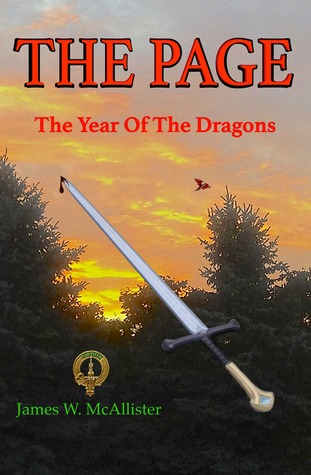
Reviews for The Page and The Eternal Savage
Hi everyone. I know usually I only do one book review at a time. However today I'm pleased to say that I will be reviewing two books today.
A heroic knight, villains and dragons working together, and the mystical sword Excalibur. Padraig finds himself questing to rescue a maid from an evil dragon only to be caught up in a war to change the fate of our world. I enjoyed the creativity and imagination regarding what happened after the fall of Camelot. Some parts are a little slow, but overall an enjoyable read for all lovers of fantasy.
Caution
There is some mild swearing in this book. A few times it is mentioned that a knight takes a bath in front of a shocked page. Dragons bleed quite a lot when killed and are mentioned as killing people and eating their liver (though thankfully the characters never see it).
Lessons
When we think ourselves as above others we are prone to fall. The greatest form of love is to be willing to give your life for another. When we use the means God has given us to help others we can accomplish great things. Evil is no match for the power of good.
Rating
4 out of 5 stars
The Eternal Savage (or The Eternal Lover as my e-book copy is titled) is about Nu, a cave-man who sets out to kill a Smilodon (or Saber-tooth cat) so he can bring the head back and claim Na-Tul, the love of his life, as his mate. However things go wrong and Nu finds himself in the twentieth-century Africa where he meets up with Tarzan and has some adventures before returning back to his time period where he continues to work for Na-Tul.
With all the discoveries made in science we now know that such a story is impossible. Dinosaurs and man didn't live in the same time period, and several of the prehistoric mammals were in the wrong area. Still I enjoyed Nu's loyalty towards Na-Tul and the lengths he went to save her from harm. The ending might surprise you. However if you enjoy the works of Edgar Rice Burroughs you won't want to miss this.
Caution
Nu for most of the story only wears a loin cloth. There is one moment where it mentions him taking a bath (though it doesn't go into detail). Men and animals are killed, mostly for food though the men do kill to protect themselves and others from harm. A woman is seen feeding a child and mentions her chest being exposed.
Lessons
A man and a woman are supposed to come together as husband and wife, and to cherish each other and love each other will full purpose of heart. When we mistreat others we can expect to be mistreated in the end.
Rating
3 out of 5 stars
A heroic knight, villains and dragons working together, and the mystical sword Excalibur. Padraig finds himself questing to rescue a maid from an evil dragon only to be caught up in a war to change the fate of our world. I enjoyed the creativity and imagination regarding what happened after the fall of Camelot. Some parts are a little slow, but overall an enjoyable read for all lovers of fantasy.
Caution
There is some mild swearing in this book. A few times it is mentioned that a knight takes a bath in front of a shocked page. Dragons bleed quite a lot when killed and are mentioned as killing people and eating their liver (though thankfully the characters never see it).
Lessons
When we think ourselves as above others we are prone to fall. The greatest form of love is to be willing to give your life for another. When we use the means God has given us to help others we can accomplish great things. Evil is no match for the power of good.
Rating
4 out of 5 stars
The Eternal Savage (or The Eternal Lover as my e-book copy is titled) is about Nu, a cave-man who sets out to kill a Smilodon (or Saber-tooth cat) so he can bring the head back and claim Na-Tul, the love of his life, as his mate. However things go wrong and Nu finds himself in the twentieth-century Africa where he meets up with Tarzan and has some adventures before returning back to his time period where he continues to work for Na-Tul.
With all the discoveries made in science we now know that such a story is impossible. Dinosaurs and man didn't live in the same time period, and several of the prehistoric mammals were in the wrong area. Still I enjoyed Nu's loyalty towards Na-Tul and the lengths he went to save her from harm. The ending might surprise you. However if you enjoy the works of Edgar Rice Burroughs you won't want to miss this.
Caution
Nu for most of the story only wears a loin cloth. There is one moment where it mentions him taking a bath (though it doesn't go into detail). Men and animals are killed, mostly for food though the men do kill to protect themselves and others from harm. A woman is seen feeding a child and mentions her chest being exposed.
Lessons
A man and a woman are supposed to come together as husband and wife, and to cherish each other and love each other will full purpose of heart. When we mistreat others we can expect to be mistreated in the end.
Rating
3 out of 5 stars
Friday, August 16, 2013
Creatures for Book 2
Hi everyone. One of the mistakes I made with my first book was the use of too many different species. That was something I was hoping to correct with the second installment in the Myths of Dymos series. However there was something I wanted help with: I want to know which creatures you would like to see in this next adventure. This is just a list of what I was considering thus far. I'd greatly appreciate your feedback and suggestions on what you would like to see Josun and his friends encounter in the land of Bylouth. If you know of something that isn't on the list that you would like to see in book two please let me know. Just post your suggestions in the comments section below, or if you do not have an account connected to Blogger please feel free to comment on Facebook. Now on to the list:
Mythical
Centaur
Minotaur
Giant
Dwarf
Elf
Dragon
Griffin
Hippogriff
Pegasus
Meriod
Roomar Vulshur
Alieron
Goblin
Troll
Ogre
Werewolf
Satyr
Harpy
Basilisk
Cockatrice
Cerberus
Othrus
Oberus (possible new creature or name for new character. Haven't decided yet.)
Fairy
Pixie
Sprite
Dryad
Naiad
Oread
Quinotaur
Tarasque
Peluda
Unicorn
Boar based off of the boars from Greek Mythology
Deer based off of the Ceryneian Hind
8-legged horse
Gnome
Salamander
Mermaid/Merman
Sea Serpent
Kraken
Selkie
Ichthyocentaur
Hippocampus
Magic users (wizards, witches, etc)
Melusine
Cyclopes
Gorgons
Gargoyles
Lindworm
Drake
Wyvern
Prehistoric
Torvosaurus
Megalosaurus
Baryonyx
Dacentrurus
Hypsilophodon
Aristosuchus
Parasol Ant (what the book Walking with Beasts called the ants from the first part of the documentary)
Godinertia
Leptictidium
Gastornis/Diatrama
Ambulocetus
Cetiosaurus
Hypseleosaurus
Ampelosaurus
Lilliensternus
Pyroraptor
Iguanodon
Pelicanimimus
Camtosaurus
Plateosaurus
Ornithoceirus
Anurognathus
Peteinosaurus
Ramphorynchus
Archaeopteryx
Neovenator
Compsognathus
Elasmotherium
Auroch
Lexovisaurus
Mammoth
Megaloceros
Propaleotherium
Meganuera
Arthropluera
Edaphrosaurus
Dimetrodon
Seymouria
Cephalaspis
Brontoscorpio
Pterygotus
Cameroceras
Pulmonoscorpius
Woolly Rhino
Eurotamandua
Woolly Mammoth
Hyaenadon
Entelodon
Calicotherium
Crassigyrinus
Cave Bear
Cave Hyena
Homotherium
Monday, June 20, 2011
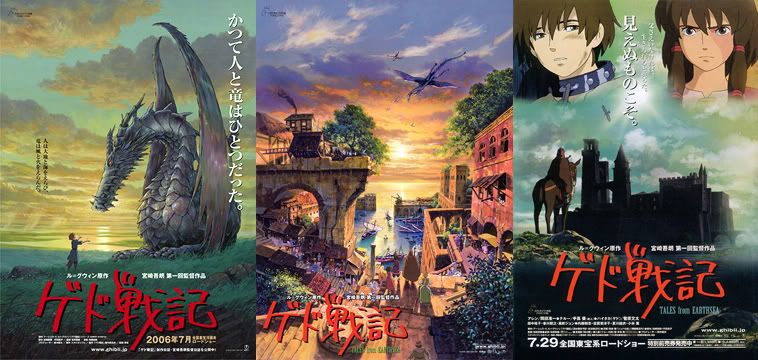
Thoughts on Tales from Earthsea
Sorry about the lack of blogging, but I was waiting for an event to happen that never did. To make up for it, I decided to do something different and blog about a movie I recently saw. That movie is Studio Ghibli's Tales from Earthsea.
The first film to be directed by Goyo Miyazaki, the son of Hayao Miyazaki, the film is loosely based on the Earthsea books by Ursula K. Le Guin. In the film, something wrong is going on in Earthsea. Magic is disappearing and dragons have been spotted fighting each other. The wizard Sparrowhawk sets out to find out what is going on. Along the way, he encounters the prince Arren, who is running from something dark. The two of them travel together to right the wrong that is happening in Earthsea and learn the importance of accepting the fate that all life must experience.
The Earthsea books have been loved by fans of Narnia and Middle-Earth alike, and Studio Ghibli has had a history of presenting memorable films. However, the film disappointed people all over the world. The film took many ideas and elements out of each book in the series and tried to merge them into one new story. The result wasn't accepted. The film got the "Worst Film" award in Japan, and Goyo was given the "Worst Director" award. The author, who's a big fan of Studio Ghibli, was disappointed with the results. She said that "It's not my book. It's your movie."
The movie did have some good points though. The film had music that made the world seem magical, and the landscape is unlike what you usually see in an epic fantasy film. The dragons were designed in an interesting way. They were given serpentine bodies that still kept the modern look of dragons, a creature of incredible power and strength. My overall opinion of Tales from Earthsea is that if you haven't read the books, you'll like the movie, but if you've enjoyed the series, maybe you should stick with the books.
The Earthsea books have been loved by fans of Narnia and Middle-Earth alike, and Studio Ghibli has had a history of presenting memorable films. However, the film disappointed people all over the world. The film took many ideas and elements out of each book in the series and tried to merge them into one new story. The result wasn't accepted. The film got the "Worst Film" award in Japan, and Goyo was given the "Worst Director" award. The author, who's a big fan of Studio Ghibli, was disappointed with the results. She said that "It's not my book. It's your movie."
The movie did have some good points though. The film had music that made the world seem magical, and the landscape is unlike what you usually see in an epic fantasy film. The dragons were designed in an interesting way. They were given serpentine bodies that still kept the modern look of dragons, a creature of incredible power and strength. My overall opinion of Tales from Earthsea is that if you haven't read the books, you'll like the movie, but if you've enjoyed the series, maybe you should stick with the books.
Tuesday, November 9, 2010
Dragons Through the Ages
One of the most common creatures to encounter in the realm of fantasy, whether it's in a book, a movie, or in a country's legends or myths, is the dragon. Almost every culture that exists on this planet has a dragon of some sort. Sometimes they're large, winged reptiles that eat damsels and fight knights, other times they're protectors of nature and symbols of power. The question that I'm going to answer is: What is it about dragons that makes them so popular?
To answer this question, we must look back through the history of the dragon. The earliest cultures told stories of large, snakelike creatures that were said to be the bringer of storms and thunder. The Greeks called these creatures draco (which translates into English as dragon). Oftentimes they would be guarding treasure or something extremely valuable which the local town or village would be in desperate need of. Usually the legends would have some hero rise up to face and slay the beast (occasionally at the cost of their own life). These tales are common in stories from medieval Europe, but they have their origins in Greek and Babylonian folklore. To these people, the dragon would symbolize something terrible that held the promise of wealth once the big nasty reptile was out of the way.
Not every culture viewed dragons in such a way. In Asian cultures (particularly China and Japan) the dragon was worshiped oftentimes as a diety that would bring rain in times of drought. They still maintained the serpentine look, but this time they had clawed feet (varying from 5 to 3). The people of China believe that dragons are a sign of good luck, and still honor the dragon by having dragons in their new year celebrations. Never once did these creatures seek to eat anyone, and this may be the reason why they have survived into modern times.
Dragons are also mentioned in the Bible, but this time they are portrayed once again as vile, evil creatures. The bible often uses the word dragon to describe the Devil or something fierce. It is very possible that since these were large, scary creatures, their name was used to try and make people fear that which was evil a lot more than they did before. That belief carried on over to medieval times, where dragons began to take on the form of large winged reptiles breathing fire and threatening to eat princesses and damsels in distress.
Today our depictions of dragons are similar, but sometimes they vary. Most often in these times artists, movie makers, and writers describe dragons as large dinosaur-like creatures with bat wings breathing fire (although the Chinese still hold true to their ancestral depiction of the dragon). However, now dragons are more than just large monsters that guard treasure and eat people. Authors have written dragons to be helpful companions to humans and work with them to protect the innocent (the common depictions of these are found in the Dragonriders of Pern series and the Inheritance Cycle). Video games make them large, hard-to-beat bosses that if not stopped could destroy the land. Sometimes the dragons have the power to speak, other times they don't. They can either be made lovable characters for children (like Elliot in Pete's Dragon or in Dragontales) or hideous scary creatures (like in Reign of Fire and the Harry Potter series). One thing is for sure: It is very hard not to find a dragon somewhere in the world.
So, in conclusion, what is it about dragons that has made them so popular? They have existed in almost every culture across the globe, they are large and intimidating, they can breathe fire, and they seem to be unstoppable. My guess is that the reason dragons are so popular is that they are something the entire world can identify in the world of fantasy.
To answer this question, we must look back through the history of the dragon. The earliest cultures told stories of large, snakelike creatures that were said to be the bringer of storms and thunder. The Greeks called these creatures draco (which translates into English as dragon). Oftentimes they would be guarding treasure or something extremely valuable which the local town or village would be in desperate need of. Usually the legends would have some hero rise up to face and slay the beast (occasionally at the cost of their own life). These tales are common in stories from medieval Europe, but they have their origins in Greek and Babylonian folklore. To these people, the dragon would symbolize something terrible that held the promise of wealth once the big nasty reptile was out of the way.
Not every culture viewed dragons in such a way. In Asian cultures (particularly China and Japan) the dragon was worshiped oftentimes as a diety that would bring rain in times of drought. They still maintained the serpentine look, but this time they had clawed feet (varying from 5 to 3). The people of China believe that dragons are a sign of good luck, and still honor the dragon by having dragons in their new year celebrations. Never once did these creatures seek to eat anyone, and this may be the reason why they have survived into modern times.
Dragons are also mentioned in the Bible, but this time they are portrayed once again as vile, evil creatures. The bible often uses the word dragon to describe the Devil or something fierce. It is very possible that since these were large, scary creatures, their name was used to try and make people fear that which was evil a lot more than they did before. That belief carried on over to medieval times, where dragons began to take on the form of large winged reptiles breathing fire and threatening to eat princesses and damsels in distress.
Today our depictions of dragons are similar, but sometimes they vary. Most often in these times artists, movie makers, and writers describe dragons as large dinosaur-like creatures with bat wings breathing fire (although the Chinese still hold true to their ancestral depiction of the dragon). However, now dragons are more than just large monsters that guard treasure and eat people. Authors have written dragons to be helpful companions to humans and work with them to protect the innocent (the common depictions of these are found in the Dragonriders of Pern series and the Inheritance Cycle). Video games make them large, hard-to-beat bosses that if not stopped could destroy the land. Sometimes the dragons have the power to speak, other times they don't. They can either be made lovable characters for children (like Elliot in Pete's Dragon or in Dragontales) or hideous scary creatures (like in Reign of Fire and the Harry Potter series). One thing is for sure: It is very hard not to find a dragon somewhere in the world.
So, in conclusion, what is it about dragons that has made them so popular? They have existed in almost every culture across the globe, they are large and intimidating, they can breathe fire, and they seem to be unstoppable. My guess is that the reason dragons are so popular is that they are something the entire world can identify in the world of fantasy.
Subscribe to:
Posts (Atom)